About the Award
Two Troland Research Awards of $75,000 are given annually to recognize unusual achievement by early-career researchers (preferably 45 years of age or younger) and to further empirical research within the broad spectrum of experimental psychology.
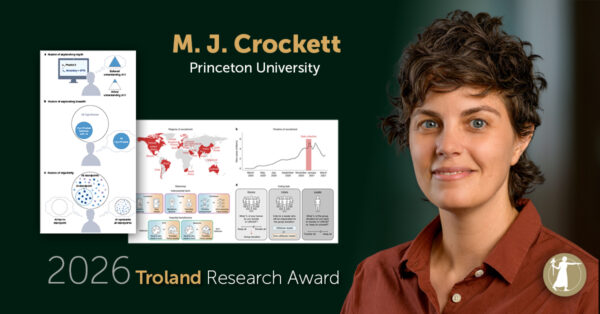
M. J. Crockett, Princeton University, and Jason D. Yeatman, Stanford University will each receive a 2026 Troland Research Award.
Crockett’s cutting-edge work has redefined our understanding of moral cognition.
Their research investigates relationships between self and society, power and knowledge, technology and culture. Much of their work seeks to understand the nature of epistemic injustice. Through timely and elegant empirical studies, Crockett’s work has elucidated the role that learning and decision processes play in diverse moral behaviors and has shown how technologies such as social media can exploit these processes to erode trust in communities.
Crockett’s work has significantly advanced our understanding of moral cognition, not only through original empirical discoveries, but through an expansive and interdisciplinary
approach that is reshaping how psychologists think about morality in real-world
contexts.
Yeatman’s pioneering work has elucidated the brain processes that underlie reading acquisition, fundamentally advancing how educators and scientists approach teaching children to read.
His research investigates the neural mechanisms that underlie the process of learning to read, how these mechanisms differ in children with dyslexia, and how literacy intervention programs can be tailored to address a wide spectrum of learning differences. Yeatman uses structural and functional neuroimaging to study how instructional experience shapes the development of brain circuits specialized for reading.

Yeatman’s work identified a critical developmental window during which the plasticity of white matter fiber pathways in the brain coincides with the ability of children to benefit most from reading instruction. Combining quantitative brain imaging measures with tightly controlled educational interventions has led to a new understanding of the interplay between white matter plasticity and learning. He has translated these insights into impactful intervention strategies and education technology that is now widely used in schools across the country.
Watch them receive the awards online during the 163rd NAS Annual Meeting on April 26th.
Award History
The Troland Research Award was established by a trust created in 1931 by the bequest of Leonard T. Troland (1889–1932), an American physicist, psychologist, and psychical researcher, who served as a member of National Research Council committees on vision and aviation psychology. The first award was presented in 1984 to Edward N. Pugh for his distinguished, quantitative psychophysical work on mechanisms of color adaptation and to encourage his physiological work on mechanisms of receptor transduction and sensitivity control.
Most Recent Recipient
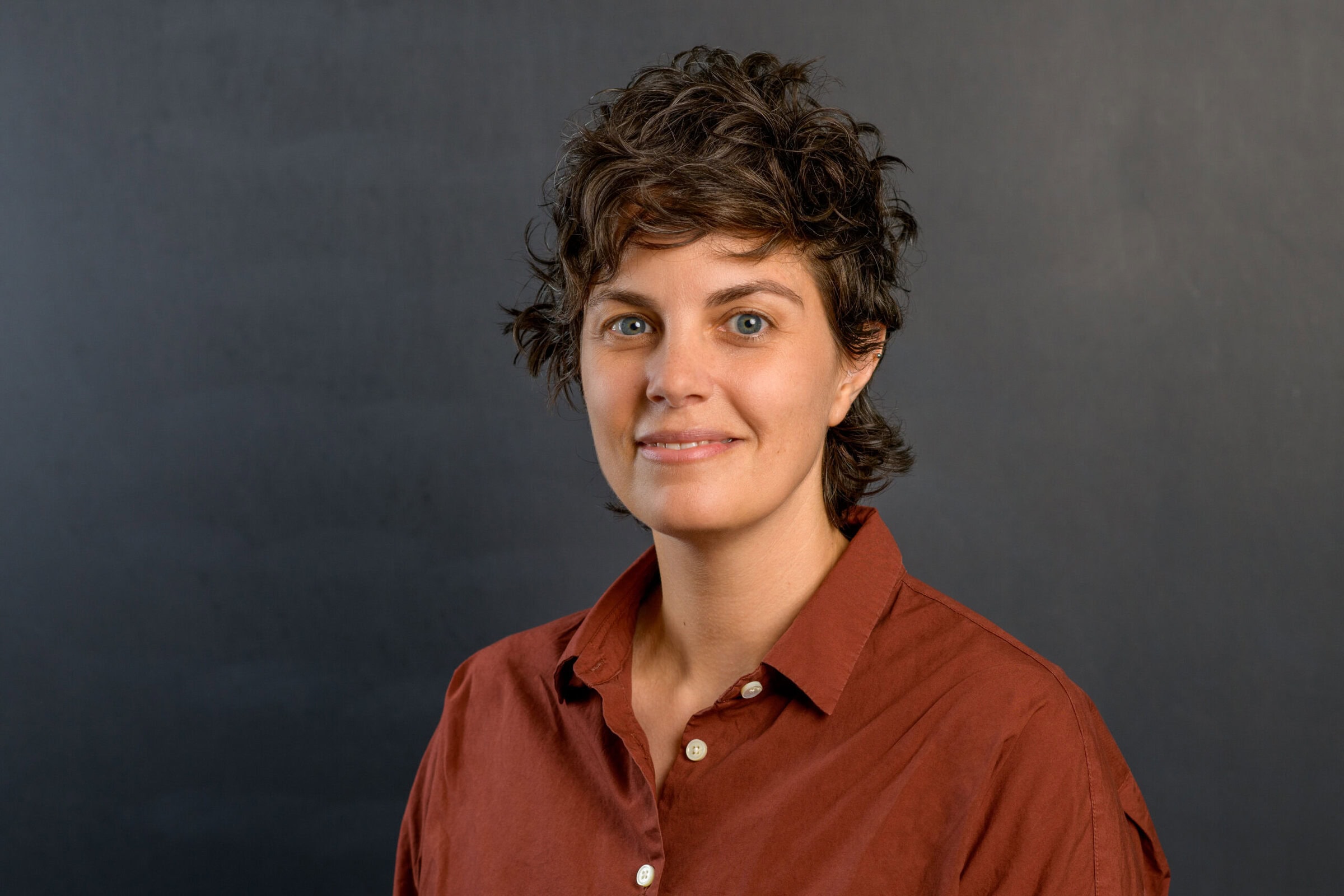
M. J. Crockett
2026